By JW Tool Box
College Essay Word Count Guide 2026: Common App, Personal Statement, and Supplemental Limits
A practical college essay word count guide covering Common App limits, personal statements, and supplemental essays, plus a fast editing workflow for trimming without weakening your story.
Why trust this guide
- Written by JW Tool Box around the actual workflow or linked tool on this page.
- Updated when browser behavior, file handling, or platform dimensions change in ways that affect the steps.
- Focused on practical settings, safe defaults, and real tradeoffs instead of generic filler.
TL;DR - The Common App personal essay is typically 250 to 650 words, while supplemental essays often land around 100 to 250 words. Use a live Word Counter while drafting, then compare cuts with the Text Diff Checker so you trim repetition instead of deleting the part that makes the essay sound like you.
If you are searching for the right college essay word count, you usually do not have a writing problem first. You have a constraint problem.
You know what you want to say. The problem is fitting it into a limit without making the essay flat, rushed, or generic.
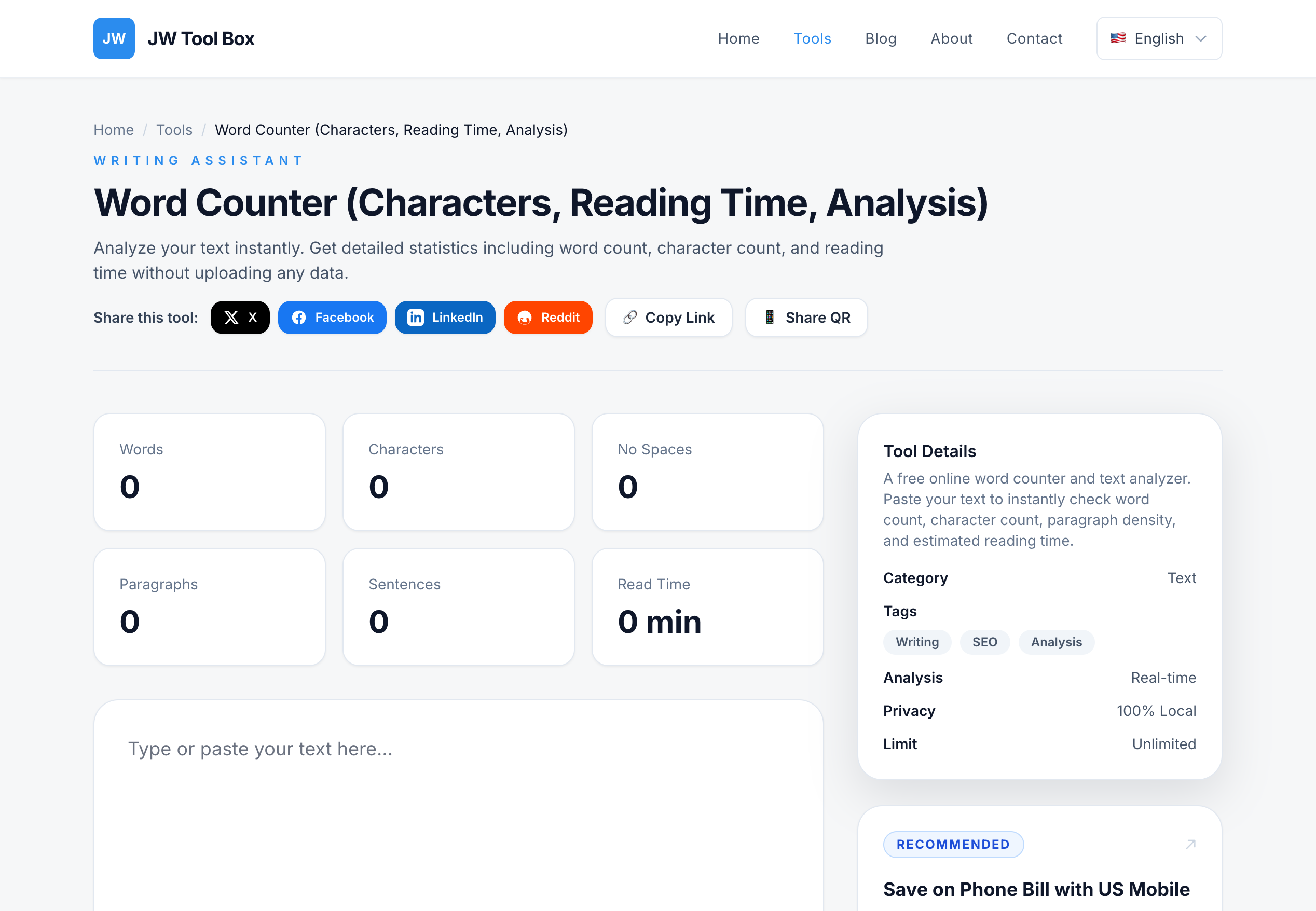
That is exactly where a live Word Counter is useful. Instead of guessing whether your draft is "close enough," you can see the number update as you revise and make cleaner decisions faster.
Quick Answer: How Long Should a College Essay Be?
Here is the practical version:
| Essay Type | Typical Range | What to Aim For |
|---|---|---|
| Common App personal essay | 250-650 words | 550-650 if the story needs space |
| Short supplemental essay | 100-150 words | Stay tight and specific |
| Standard supplemental essay | 200-250 words | One idea, one example, one takeaway |
| Longer school-specific response | 300-500 words | Use structure and transitions carefully |
For the main personal essay, you usually do not want to submit something extremely short unless you have an unusually compact story. A 300-word response can feel underdeveloped when the application gives you much more room.
At the same time, 650 is a ceiling, not a target you have to hit. A strong 590-word essay is better than a padded 650-word essay that repeats itself.
Common App Essay Limit: What Actually Matters
For the main Common App personal essay, the useful rule is simple:
- Stay inside the allowed range.
- Leave enough room for a real scene, reflection, and conclusion.
- Do not stretch the essay just to look "full length."
If you are deciding between 610 and 648 words, the difference is not the number itself. The difference is whether the extra 38 words improve clarity.
Extra words are worth keeping when they:
- sharpen the setting
- clarify what changed in your thinking
- make the ending more concrete
Extra words are dead weight when they:
- repeat information already in your activities list
- explain the lesson three different ways
- over-describe the setup before the essay gets interesting
How Long Should Supplemental Essays Be?
This is where students get tripped up. They treat every prompt like a mini personal statement, then run out of space.
Most supplemental essays reward precision more than emotional buildup. If a school gives you 150 words, it is usually testing whether you can answer directly and specifically.
Here is the easiest way to think about common supplemental ranges:
50 to 75 words
Treat this like an expanded short answer.
Best structure:
- Name the focus.
- Give one concrete detail.
- End with a specific reason or outcome.
100 to 150 words
You have enough space for one strong example, but not enough for a long backstory.
Best structure:
- Direct answer in the first sentence.
- One supporting detail.
- One sentence connecting that detail to the school or prompt.
200 to 250 words
This is the sweet spot for many "Why us?" and community prompts. You can show fit, but you still need discipline.
Best structure:
- Clear thesis.
- Two specific supporting points.
- Short closing sentence that sounds intentional, not sentimental.
The Best Drafting Workflow for Staying on Limit
Most students wait until the very end to check the count. That is backwards.
A better workflow looks like this:
Step 1: Draft long on purpose
Write the first draft without obsessing over every line. If your target is 650 words, it is normal for the first version to come out at 750 to 900.
That does not mean the draft is bad. It usually means you have material to shape.
Step 2: Paste into the Word Counter
Watch the live count while revising. This matters because word limits are easier to manage when the feedback is instant.
What to watch:
- total words
- paragraph length
- whether the opening is eating too much space
Step 3: Cut by category, not by panic
When a draft is too long, cut in this order:
- Repeated setup
- Generic conclusion lines
- Resume-style facts already shown elsewhere
- Adverbs and filler transitions
- Sentences that explain what the reader already understood
Step 4: Compare old and new drafts side by side
Open the Text Diff Checker and compare your longer draft with the trimmed version.
This is the fastest way to see whether you removed:
- clutter
- or the line that made the essay memorable
If the deleted material only slows the reader down, good cut.
If the deleted material removes the emotional turn or the reason the story matters, put part of it back.
What Makes an Essay Feel Too Long Even Before It Hits the Limit
Two essays can both be 620 words. One feels crisp. The other feels exhausting.
That difference usually comes from structure, not raw count.
Your essay feels too long when:
- the first paragraph takes too long to get to the actual moment
- the middle repeats the same point in slightly different wording
- the ending explains the moral instead of letting the story prove it
Your essay feels efficient when:
- the opening starts close to the real tension
- each paragraph adds new information
- reflection is specific instead of inspirational-sounding
Common College Essay Word Count Mistakes
Mistake 1: Writing to the maximum before you have a point
If you start with "I need 650 words," you will often fill space before you know the essay's center.
Start with the moment, conflict, or realization first. Count second.
Mistake 2: Treating the essay like a life summary
The personal essay is not supposed to cover your entire identity. It needs one clear through-line.
Trying to fit academics, family, sports, volunteering, and future goals into one essay is the fastest way to create a vague 650-word draft.
Mistake 3: Leaving trimming until the night before
Good cuts are thoughtful. Last-minute cuts are usually clumsy.
When you revise early, you can reduce 90 words by removing repetition. When you revise late, you end up deleting the sentence that made the piece personal.
Mistake 4: Assuming shorter is always stronger
A short essay is only strong when it still feels complete.
If the reader finishes and thinks, "That was interesting, but I still do not know why this mattered," the essay is too thin, even if it is under the limit.
How to Trim 100 Words Without Weakening the Essay
Here is a simple example of where word savings usually come from:
- Replace long introductions with one vivid sentence.
- Cut throat-clearing phrases like "I remember when" or "I learned that."
- Merge two weak sentences into one stronger sentence.
- Delete lines that only restate the prompt.
- Keep the concrete detail; cut the commentary that repeats it.
A surprisingly reliable rule: if you can delete a sentence and the paragraph still means the same thing, that sentence probably did not earn its spot.
FAQ
Is 650 words better than 590?
Not automatically. The better essay is the one that feels complete and controlled.
Is 620 words a safe target?
Yes. For the main personal essay, something in the low-600s often gives you enough room to sound developed without inviting padding.
Can I submit exactly 650?
Yes, if every sentence is doing real work.
What about school-specific supplements?
Always follow the individual prompt limit first. Many colleges use much shorter limits than the main personal essay.
Should I cut the conclusion first?
Only if it is repeating the lesson. Many essays improve when the ending becomes shorter and more concrete, but the right move depends on where the draft is wasting space.
Final Editing Checklist
Before you submit, confirm that:
- the essay fits the word limit comfortably
- the first paragraph gets to the point quickly
- each paragraph adds something new
- the ending sounds earned, not pasted on
- the count was checked in a live Word Counter
- major revisions were compared in the Text Diff Checker
If you can answer yes to all six, your word count is probably under control and your editing process is probably stronger than most applicants' already.
If you want a fast way to tighten a draft before submission, open the Word Counter, trim the obvious repetition, then run the final version against the Text Diff Checker so you can see exactly what changed.
About the author
JW Tool Box - Editorial and product review team
JW Tool Box publishes hands-on guides tied directly to the site's browser-based tools. Content is updated when browser behavior, platform rules, or product requirements change in ways that affect real workflows. The goal is to provide practical instructions, tested defaults, and trustworthy reference content instead of thin keyword filler.
Related guides
-
Essay Word Count Guide 2026: Standards for College, Blogs, Books & Social Media
TL;DR — College essay: 500–650 words. SEO blog post: 1,500–2,500. Novel: 70,000–100,000. Check your current count with the Word Counter → In 2026, the algorithm rewards depth, and literary agents automatically reject manuscripts that don't fit market molds. So exactly how long should your writing be? Whether you are trying to rank an SEO blog post without looking like an AI content farm, draft…
-
Free Online Word Counter — Count Words, Characters & Reading Time
Need to hit a word limit for an essay, stay under a character cap for social media, or estimate reading time for a blog post? Our Free Word Counter gives you instant results—no signup, no upload, works entirely in your browser. Try It Now → Open the Word Counter Tool — paste or type your text and see results instantly. What Gets Counted
Related tools
Additional browser-based utilities that are closely related to this workflow.
-
Text Diff Checker (Compare, Highlight, Difference)
Highlight differences between two blocks of text in seconds.
-
Word Counter (Characters, Reading Time, Analysis)
Count words, characters, and estimate reading time in real-time.